Stitch, Please: How the Ancient Art of Embroidery Became the Ultimate Cure for a Screen-Fried Brain
Let's paint a picture. It's 11 p.m. on a Tuesday. You've watched three hours of content you won't remember by Thursday, your eyes feel like two little raisins baking in the Mojave, and your brain is doing that thing where it's simultaneously exhausted and completely incapable of shutting off. Sound familiar? Yeah. We thought so.
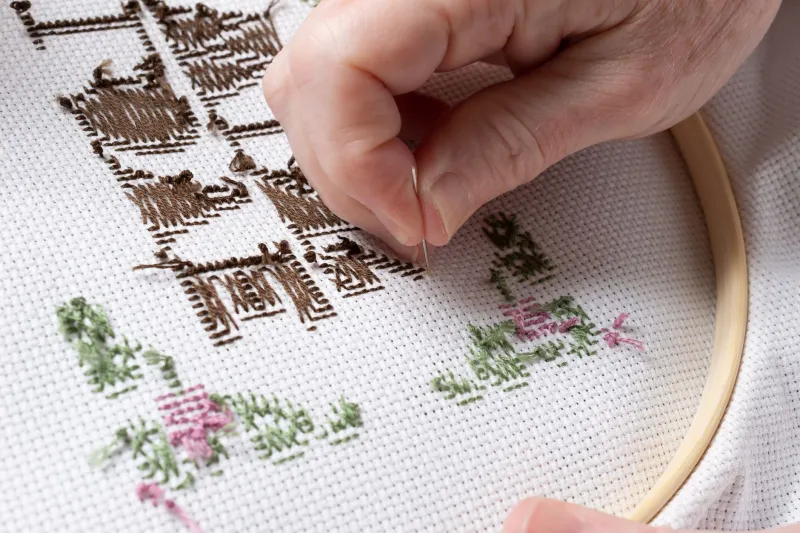
Now imagine instead you're sitting in a cozy chair, soft lamp glowing, a wooden embroidery hoop in your hands, and you're slowly, methodically pulling a strand of dusty rose floss through a piece of linen to form the petal of a flower. Nobody is asking anything of you. No notifications. No discourse. Just you, the needle, and the deeply meditative act of making something beautiful from scratch.
Welcome to the great needlework revival — where cross-stitch and embroidery have officially become the hottest analog hobby for the most digitally exhausted generation in human history.
From Grandma's Parlor to Your Instagram Feed
Here's the delicious irony at the heart of this whole trend: people are escaping the internet by doing a craft they then photograph and post on the internet. But hey, nobody said the revolution had to be perfectly logical.
Cross-stitch and embroidery have been around for literal centuries — we're talking ancient China, medieval Europe, your great-aunt Mildred's powder room wall. For a long stretch, needlework carried a certain image. Doilies. Framed bluebirds. "Home Sweet Home" in a font that hadn't been cool since 1987. And then, somewhere around the last few years, something cracked open.
Crafters started stitching things that were decidedly not bluebirds. Mushrooms with little faces. Retro diner signs. Phrases that would make Aunt Mildred fan herself in alarm. Suddenly, needlework had an edge — and more importantly, it had a community. Platforms like TikTok and Reddit's r/CrossStitch exploded with people sharing their works in progress, their pattern recommendations, their hard-won tips on how to prevent your floss from turning into an absolute goblin's nest of knots.
"I found a cross-stitch kit at a thrift store on a total whim," says Dani, a 29-year-old graphic designer from Portland, Oregon. "I figured it would be a funny weekend thing. That was two years and forty-seven finished pieces ago. I genuinely think it saved my mental health."
The Science Behind the Stitch
Dani's experience isn't just anecdote — it's increasingly backed by actual research, which is a sentence that would have baffled any cross-stitcher circa 1995.
The repetitive, rhythmic nature of needlework activates what psychologists sometimes call the "relaxation response" — the same physiological state targeted by mindfulness meditation and deep breathing exercises. Your heart rate slows. Cortisol levels drop. The part of your brain that's been white-knuckling the news cycle for the last several years finally, finally gets a breather.
"There's something really powerful about an activity that demands just enough of your attention that you can't spiral," explains the logic behind what therapists call "flow state" crafting — activities complex enough to be engaging but not so demanding that they become stressful. Needlework hits that sweet spot with almost suspicious precision.
It also produces something increasingly rare in modern life: a tangible, finished object. You made a thing. With your hands. It exists in the physical world. In an era of ephemeral content and digital everything, that's practically radical.
Patterns With Personality
If you're picturing a starter kit with a single sad kitten on the front, allow us to dramatically expand your horizons.
The contemporary needlework scene is wild with creativity. Trending right now are retro-inspired patterns that lean hard into the vintage aesthetic — think 1950s diner motifs, groovy 70s mushroom and rainbow designs, old-school motel signs rendered in DMC floss, and kitschy botanical illustrations that look like they escaped from a 1962 seed catalog. There are patterns that recreate vintage album covers, pixel-art tributes to classic arcade games, and an entire cottage industry of designers making cross-stitch versions of iconic retro TV show logos.
Etsy is basically a wonderland for pattern hunters. Shops like Cloudsfactory, WeirdCrossStitch, and dozens of indie designers are churning out downloadable PDFs that cater to every aesthetic niche imaginable. The retro-kitsch corner of the market is particularly booming — because nothing scratches the nostalgia itch quite like recreating a 1970s harvest gold refrigerator in 14-count Aida cloth.
"I specifically look for patterns that feel like they time-traveled," says Marcus, a 34-year-old teacher from Austin, Texas, who picked up embroidery during a particularly brutal bout of pandemic-era insomnia and never looked back. "There's something so soothing about making something that looks like it belongs in a different decade entirely."
The Hoop Collective: Finding Your Tribe
One of the more quietly wonderful things about the needlework revival is the community that's grown up around it — online, yes, but also increasingly in person.
Stitch-and-bitch groups (the term has been lovingly reclaimed, we promise) are popping up in coffee shops, libraries, and community centers across the country. They're part craft circle, part therapy session, part excuse to eat an unreasonable number of snacks in the company of people who won't judge you for your seventeen unfinished projects.
Online, the communities are even bigger. The r/Embroidery subreddit has hundreds of thousands of members sharing everything from breathtaking fine-art pieces to proudly imperfect first attempts. Facebook groups dedicated to specific designers or styles have become genuine social hubs. There are Discord servers where stitchers share progress photos at midnight and cheer each other through complicated pattern sections like the world's most wholesome sports fans.
"It's the least toxic corner of the internet I've ever found," Dani says, and honestly, that alone might be worth the price of a beginner's kit.
Threading the Needle on Getting Started
If your fingers are twitching with curiosity — and given everything we've just told you, they probably should be — getting started is genuinely easy and pretty inexpensive.
A basic embroidery starter kit (hoop, needles, a sampler pattern, and a rainbow of floss) runs anywhere from $15 to $30 at craft stores like Joann, Michael's, or online. Cross-stitch kits are similarly accessible, and the pattern libraries available for free on sites like Ravelry or through a simple Etsy search are essentially infinite.
YouTube is your best friend for learning the foundational stitches — the humble running stitch, the satisfying satin stitch, the fancy French knot that will make you feel like an absolute textile genius the first time you pull one off successfully. There are channels with millions of subscribers dedicated entirely to teaching needlework techniques, which is a genuinely beautiful fact about the world.
Start small. Finish something. Feel disproportionately proud of yourself. Repeat.
Put Down the Phone, Pick Up the Hoop
Here's the thing about cross-stitch and embroidery that nobody really talks about: they're not just a hobby. They're a small, quiet act of rebellion against the pace of modern life. Every stitch is a tiny declaration that you are, in fact, a person with hands and patience and the capacity to make something lovely without a single algorithm involved.
And when you frame that finished piece and hang it on your wall — whether it's a serene botanical sprig or a cheeky retro slogan your great-aunt Mildred would absolutely not approve of — you'll have something that no app update can delete, no subscription can expire, and no platform can take away.
Stitch, please. You've earned it.