Gotta Catch 'Em All: Inside the Wonderfully Unhinged World of Vintage Telephone Collecting
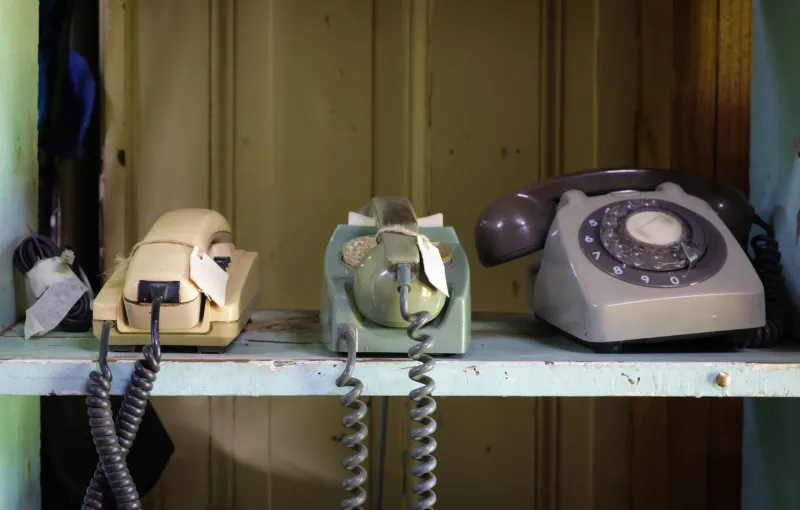
Somewhere in suburban Ohio, a man named Gerald is on his hands and knees at an estate sale, heart pounding, palms sweating — not because he spotted a first-edition baseball card or a mint-condition comic book. No. Gerald has just locked eyes with a 1955 Western Electric Model 500 in harvest gold. And he needs it like he needs oxygen.
Welcome to the world of vintage telephone collecting, where grown adults with mortgages and strong opinions about coffee grinders spend their weekends chasing down rotary-dial relics with the same feverish energy that kindergartners bring to a birthday piñata. It is spectacular. It is gloriously nerdy. And it is so much more serious than you'd ever expect.
The Phone Call You Didn't Know You Were Waiting For
Here's the thing nobody tells you: vintage telephones are not all the same. Not even close. From the chunky, art-deco glamour of 1930s Bakelite desk sets to the sleek, space-age cradles of early 1960s Princess phones, the variation in form, color, and manufacturer is staggering — and that variety is precisely what makes collecting them so addictive.
Serious collectors track differences between Bell System models and independent manufacturers like Automatic Electric and Stromberg-Carlson the way audiophiles argue about turntable cartridges. Each era had its own design language, its own palette, its own quirks. A mid-century Western Electric 500 in standard black? Nice. A Western Electric 500 in turquoise? Now we're talking. A rare two-tone custom color commissioned for a hotel chain in 1962? Brother, that's the Holy Grail, and somebody somewhere has already paid embarrassing money for it.
The Rarity Market Is Real (and Ruthless)
If you assumed you could waltz onto eBay and scoop up a vintage telephone for pocket change, prepare for a reality check delivered via rotary dial. The market for desirable models has quietly — and then not so quietly — exploded. Common black desk phones might still run you ten to forty bucks. But step into the territory of unusual colors, unusual manufacturers, or unusual configurations, and the numbers climb fast.
Candlestick phones from the 1910s and 1920s regularly fetch several hundred dollars in good condition. A pristine Western Electric Princess phone in the original pink or red? Expect to pay triple digits without blinking. And if you stumble across a working Ericofon — that wild, single-piece Swedish design that looks like someone asked a flying saucer to moonlight as a telephone — you might as well just hand over your car payment and call it a day.
Online communities on Facebook and Reddit have become buzzing marketplaces and information hubs where collectors post finds, argue about restoration ethics (to repaint or not to repaint — a debate that gets heated), and occasionally post photos of their collections in a way that is only slightly less intense than people showing off newborns.
The Estate Sale Rush Is a Contact Sport
Ask any serious collector where the best finds come from, and the answer arrives without hesitation: estate sales. Specifically, the estate sales of people who lived through the mid-twentieth century and held onto everything. These are the sales where you might find a 1940s desk phone still sitting on a telephone table in the hallway, exactly where it's been for eighty years, complete with the little notepad holder and a phone book that predates area codes.
The strategy is almost athletic. You show up early. You make a beeline for the kitchen, the hallway, the home office. You ignore the furniture and the dishes and the decorative plates with roosters on them. You are looking for one thing, and when you find it, you do not put it down, not even to sneeze, because someone else at this sale is also looking for one thing, and their thing might be your thing, and this is not a drill.
The thrill is real and frankly a little unhinged, which is why collectors love it. There's something deeply satisfying about rescuing a gorgeous tangerine-orange desk phone from a cardboard box labeled "MISC JUNK" and knowing that you alone recognized what it was.
Functional Art for People With Excellent Taste (and a Few Quirks)
Once collectors have their prizes, the question becomes: what do you do with them? The answer, increasingly, is to treat them as exactly what they are — functional sculptures — and display them accordingly.
Home installations range from modest (a shelf of six or eight phones arranged by color like a very satisfying rainbow) to genuinely ambitious. Some collectors wire their phones back into working order using modern adapters, turning a 1958 desk phone into a fully functional piece of communication equipment that also happens to look incredible on a mid-century credenza. Others mount phones on gallery walls, arrange them by decade, or group them by manufacturer in dedicated display rooms that blur the line between personal collection and small museum.
The color angle is particularly compelling. Telephone companies spent decades developing proprietary color palettes — and the results, viewed together, are legitimately stunning. Imagine a shelf lined with phones in avocado green, harvest gold, ivory, dusty rose, cobalt blue, and burnt sienna, all of them gleaming under good lighting. That's not clutter. That's installation art, and your local gallery should be jealous.
Why Now? Why Phones?
It's worth asking why this particular hobby is having such a visible moment. Part of it is the broader retro revival — the same cultural wave that's brought back vinyl records, film cameras, and the inexplicable return of the mullet. People are hungry for objects that feel real, that have weight and history and the faint smell of a different era.
But there's something specific about telephones. They were once the most intimate technology in the home — the device through which you heard your grandmother's voice, got the news that someone was coming home, had the nervous conversation you'd been dreading. They carry emotional frequency in a way that, say, a vintage blender simply does not.
Also — and this cannot be overstated — picking up a heavy Bakelite handset and dialing a rotary phone is deeply, viscerally satisfying in a way that tapping a glass screen will never be. That mechanical resistance. That satisfying click-click-click of the dial spinning back. It's tactile joy in its purest form.
Gerald in Ohio would tell you the same thing, right after he finishes carefully wrapping that harvest gold Model 500 in bubble wrap for the drive home. He's already got three more lined up to find next weekend.
The dial tone of history is calling. You might as well pick up.