Tick Me Softly: The Delightfully Unhurried World of Analog Clock Collectors Who've Told Their Smartwatches to Take a Hike
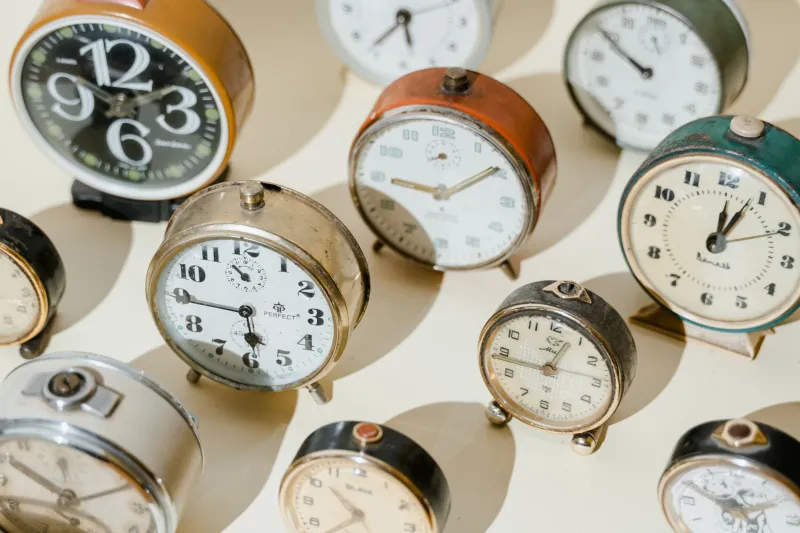
Somewhere in a Brooklyn apartment, a 27-year-old named Marcus is staring at a wall. Not in a zoned-out, doom-scrolling, existential-crisis kind of way. He's staring at a 1962 Sunburst wall clock — all splayed golden rays and a creamy ivory face — and he is genuinely at peace. His Apple Watch sits in a drawer. His phone is face-down. And the only notification he's receiving is the soft, rhythmic tick-tock that sounds, he says, "like the universe breathing."
Marcus is not alone. Across the United States, a quietly growing movement of millennials and Gen Zers is rediscovering the analog clock, that pre-digital relic your grandma had above the stove next to a ceramic rooster. Vintage timepieces — wall clocks, mantel clocks, cuckoo clocks, and wristwatches with actual hands — are flying off Etsy shops, thrift store shelves, and estate sale tables faster than you can say what time is it, anyway?
Why Now? (Or More Accurately, Why Then?)
Here's the thing about living in 2025: your phone doesn't just tell you the time. It tells you the time and reminds you that you haven't moved in 47 minutes, and flags a meeting in 12 minutes, and helpfully notifies you that someone you went to high school with just posted a photo of their brunch. Time, in the digital age, has become a weapon. Every glance at a screen is a potential ambush.
Analog clocks, bless their mechanical little hearts, don't do any of that. They just… tick. They show you two hands on a face and let you do the math yourself. It's almost aggressively low-stakes.
"There's a psychological concept called 'cognitive offloading,'" explains Dr. Patricia Voss, a behavioral researcher based in Austin, Texas, who has been studying screen fatigue. "When every device we own is optimized to grab our attention, something as simple as a clock that only tells the time becomes genuinely restorative. It asks nothing of you."
Translation: your grandmother's kitchen clock was, in fact, a wellness tool. She was ahead of her time. (Pun absolutely intended.)
The Tick-Tock Aesthetic Is Having Its Moment
Walk into any vintage shop worth its salt right now — your local Goodwill Boutique, a well-curated antique mall in Nashville, a dusty estate sale in suburban Ohio — and you'll notice the clock section has been picked over like a Black Friday electronics display. Starburst clocks from the 1950s and '60s are particularly hot, fetching anywhere from $40 to several hundred dollars depending on condition and the desperation of the buyer. Mid-century Sessions mantel clocks? Gone. Retro Lux pendulum clocks? Gone. Kitschy cuckoo clocks shaped like chalets? Surprisingly, also gone.
Designers and small-batch manufacturers have taken notice. Companies like Kikkerland and a wave of independent Etsy artisans are producing new clocks deliberately styled after the atomic age, the Art Deco period, and the groovy curves of 1970s Americana. They're selling out.
Jamie Kowalski, who runs a small clock restoration shop out of her garage in Columbus, Ohio, says business has tripled in the last two years. "I used to get mostly retirees bringing in family heirlooms," she says. "Now I've got 23-year-olds rolling in with clocks they found at their grandparents' house asking me to get them running again. They want the tick. They specifically request the tick."
The tick, it turns out, is the whole point.
The Meditation Nobody Paid $40 a Month to Subscribe To
There's a growing body of anecdotal evidence — backed up by at least some actual science — that rhythmic, repetitive sounds have a grounding, calming effect on the human nervous system. Metronomes. Rain on a window. A rocking chair on a porch. And yes, the steady, unassuming tick-tock of a mechanical clock.
For a generation that grew up being told to meditate more and put the phone down, the analog clock offers something refreshingly low-effort: ambient calm that requires zero subscription fees and absolutely no guided breathing exercises narrated by a soothing stranger.
"I have anxiety," says Priya, a 31-year-old graphic designer in Chicago who has four vintage clocks in her apartment, including a Howard Miller mantel clock she rescued from a thrift store for $12. "My therapist told me to be more 'present.' I bought a clock. Now I'm present. I can hear time passing. It's weirdly the most grounded I've felt in years."
Her smartwatch, for the record, now lives in a kitchen junk drawer alongside expired coupons and a mystery key.
The Wristwatch Renaissance (Yes, Really)
It's not just wall clocks getting a second wind. Vintage mechanical wristwatches — Seikos from the 1970s, old Bulovas, chunky Timex Marlin reissues — are having a full-blown moment among younger collectors. The market for pre-owned watches has exploded, with platforms like WatchBox and Chrono24 reporting surging interest from buyers under 35.
Part of it is aesthetics — a well-worn vintage watch just looks cooler than a rectangular screen strapped to your wrist. Part of it is the craftsmanship argument: these things were built to last decades, not to be obsolete in three years. And part of it, collectors will tell you with the gleam of a true believer, is the movement. Watching the tiny gears and springs of a mechanical watch do their intricate little dance is, apparently, deeply satisfying in a way that a touchscreen simply cannot replicate.
"It's alive," says Derek, a 29-year-old in Portland who owns eleven vintage watches and exactly zero smartwatches. "A mechanical watch is a tiny machine that's always running. It's got a heartbeat. Your Fitbit does not have a heartbeat."
Difficult to argue with that logic, honestly.
Slow Down, You Move Too Fast
Maybe the analog clock revival is, at its core, about something bigger than clocks. Maybe it's about a collective, quiet revolt against the relentless pace of modern life — the notifications, the optimization, the constant pressure to be productive, connected, and measurable at all times.
A clock with hands doesn't tell you how many steps you've taken. It doesn't alert you to a sale ending in 47 minutes. It doesn't track your sleep score or suggest you stand up. It just marks the passage of time in the most ancient, human way possible, and leaves the rest entirely up to you.
In a world that seems determined to fill every available second with information, the humble analog clock offers something almost radical: a moment that is simply, quietly, now.
Tick.
Tock.
You've got time.