You've Got Obsession: The Wild Bunch Rebuilding Fully Functional '90s Computer Shrines in Their Living Rooms
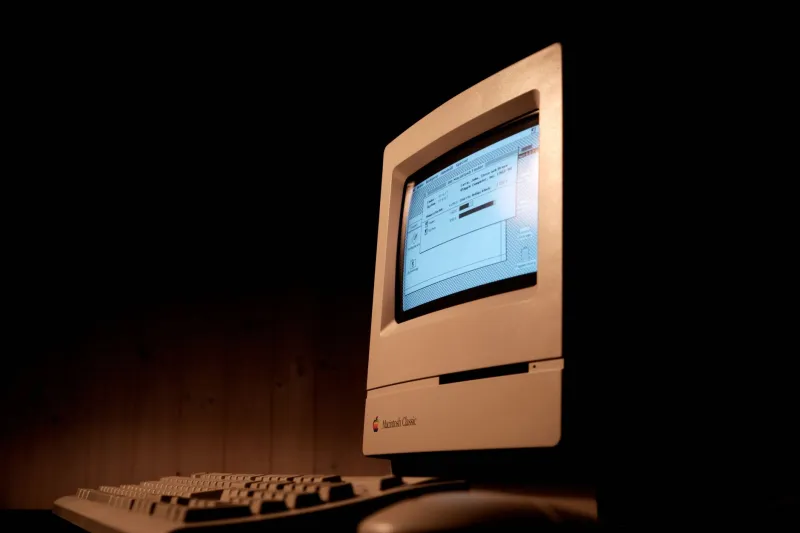
Let's paint a picture. It's a Tuesday evening. A 34-year-old software engineer named Derek — a man who spends his entire professional life staring at a paper-thin MacBook — comes home, sits down in front of a 1997 Compaq Presario with a monitor the size of a microwave, waits for the dial-up screech to subside, and opens Internet Explorer 4.0 to check a website about Animaniacs. He is, by all accounts, completely at peace.
This is not a cry for help. This is a hobby. And it is absolutely, gloriously thriving.
The Beige Revival Nobody Saw Coming
Somewhere between the fifth app update notification and the fourteenth password reset of the week, a sizable chunk of millennials collectively snapped. Not in a dramatic way — more in a quiet, deliberate, "I'm going to find a Gateway 2000 tower on eBay and I'm going to feel things" sort of way.
The retro computing underground has been bubbling for years, but lately it's boiling over. Online communities dedicated to vintage machines — think Windows 95 enthusiasts, DOS gaming purists, and full-on AOL reconstructionists — have exploded in membership. Facebook groups, Discord servers, and subreddits devoted to CRT monitors, floppy disk preservation, and early web archaeology are pulling in tens of thousands of members. These aren't just people who want to remember the '90s internet. They want to live inside it, in real time, one 28.8k modem connection at a time.
"There's something almost meditative about it," says Priya, a UX designer in Austin who has dedicated an entire spare bedroom to what she lovingly calls her "Tech Crypt." The room holds three working CRT monitors, a fully operational Windows 98 machine, and a collection of original software on CD-ROM that she describes as "my version of vinyl records." "Modern tech is designed to demand your attention constantly," she explains. "My old Compaq just sits there. It doesn't ping me. It doesn't update itself. It just is."
The Sound of Nostalgia Connecting at 56k
Ask any member of this community what their single favorite sensory experience is, and the answer is almost unanimous: the modem sound. That shrieking, warbling, alien handshake of tones that meant the internet was coming — slowly, magnificently, unstoppably — is apparently hardwired into an entire generation's nervous system as a comfort sound.
Collectors have gone to extraordinary lengths to recreate the full experience. Marcus, a middle school history teacher in Columbus, Ohio, spent eight months tracking down an original US Robotics Sportster modem so he could hear the authentic connection sequence rather than a YouTube recording. "A recording just isn't the same," he insists, with the quiet conviction of a man who has strong opinions about this. "The way it fills the room. The way you'd hold your breath waiting to see if it connected or dropped. That tension is real."
His setup includes a working Windows 95 installation, a period-correct Hewlett-Packard inkjet printer that he describes as "purely decorative," and a bookmark folder full of archived early web pages preserved through projects like the Wayback Machine. He's also recreated a working AIM client using a modern AIM revival server — complete with the buddy list door-slam sound that once defined the social lives of an entire generation.
"My students think it's the weirdest thing they've ever seen," Marcus admits. "But then one of them sat down and used it for ten minutes and said it was the most relaxed they'd felt all week. Make of that what you will."
Clunk Is the New Sleek
There's an unmistakably rebellious quality to all of this, and the collectors themselves are keenly aware of it. Modern consumer technology has spent thirty years sprinting toward thinner, faster, smoother, and more invisible. The iPhone 15 barely exists as a physical object. It's practically a rumor you hold in your hand.
The '90s PC is the antithesis of that philosophy. It is large. It is loud. It runs hot. It takes forever. The floppy drive makes a sound like a tiny, exhausted robot. The monitor weighs more than a golden retriever. And people are obsessed with it.
"It's tactile in a way nothing else is anymore," says Jenna, a graphic designer in Portland who collects vintage Macintosh computers and refers to her 1998 iMac G3 — the translucent teal one — as "the most beautiful object I own." She's not wrong, honestly. "There's a physicality to using old tech that modern stuff completely stripped away. You feel like you're computing. You hear the hard drive thinking. You experience the loading time. It's a whole thing."
Jenna also makes an aesthetic argument that's hard to dismiss. The late '90s and early 2000s produced some genuinely iconic industrial design — the candy-colored iMac line, the translucent plastic of the Power Mac G4 Cube, the satisfying click of a proper mechanical keyboard — that she believes has been unfairly erased from the cultural conversation about design history. "These machines are beautiful. They should be in museums. Some of them are."
Web Archaeology and the Early Internet Experience
Beyond the hardware, a fascinating sub-community has emerged around what enthusiasts call "early web experience" recreation. Using tools like archived Geocities pages, early Flash game preservation projects, and reconstructed web portals modeled after the original AOL and MSN homepages, collectors are essentially building time machines to the internet of 1997.
Derek — our software engineer from the opening — hosts what he calls "LAN parties for one" on occasional Saturday afternoons, where he sits with his Compaq, navigates exclusively through archived late-'90s web content, and refuses to touch his phone for a minimum of two hours. "It's genuinely the most focused I ever am," he says. "There's no social media. There's no algorithm trying to keep me there. You find something cool, you read it, and then you decide what to do next. You decide. It sounds simple but it's kind of revolutionary now."
He pauses, then grins. "Also I found a Spice Girls fan site from 1998 that still has a working guestbook and I signed it. So there's that."
Slow Tech, Fast Feelings
What ties all of these collectors together isn't just nostalgia, though nostalgia is absolutely in the room. It's something more deliberate — a conscious choice to engage with technology on their terms rather than the algorithm's. To experience the internet as a place you visited rather than a thing you lived inside. To make computing feel like an event again rather than an ambient condition of modern existence.
In a world where every device is optimized to consume your attention like a starving thing, firing up a machine that takes four minutes to boot and requires a phone line is, genuinely, a radical act.
Welcome to the rebellion. It loads slowly, it sounds like a robot arguing with a fax machine, and it is absolutely worth the wait.